
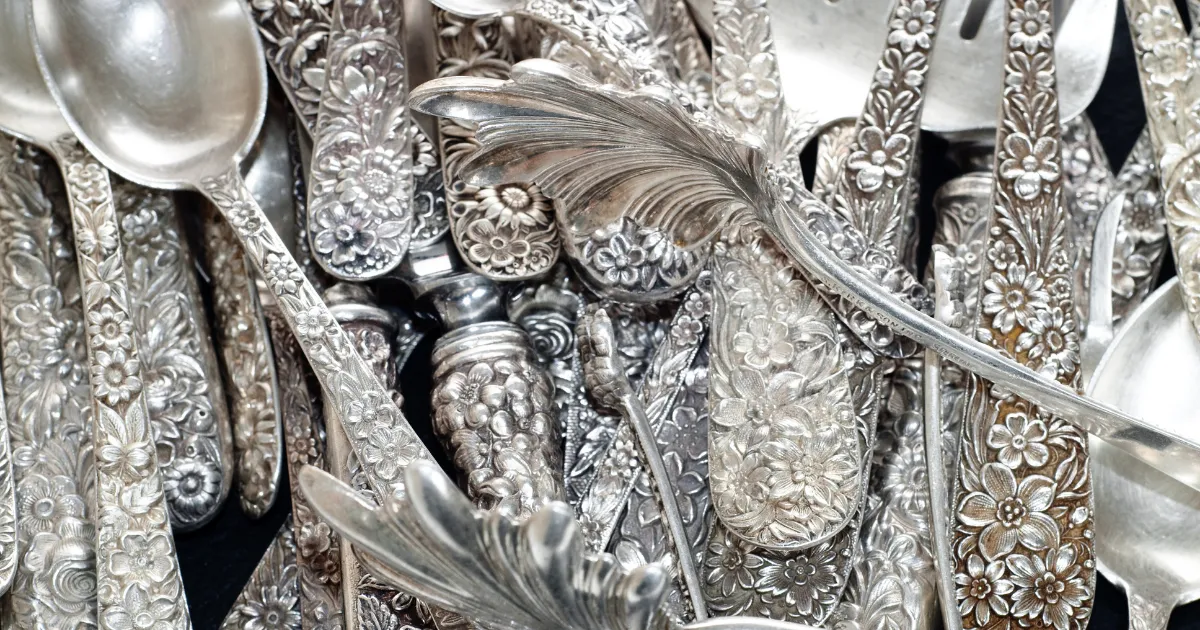
Silver comes in many forms, and not all of it is worth the same. A sterling tray and a plated tray can look nearly identical on a dining table, unless you know what to look for!
At NY Gold & Silver, we see both every day – and as professional silver buyers, we know how to tell them apart. This guide shows you how to separate solid silver from silver-plated pieces, what silver purity marks mean, which well-known makers produced only plated wares, and why weighted candlesticks and knives are not valued by their scale weight, as we must account for the weighted sections. It will also help you decide whether to bring your pieces to our storefront in Carmel, NY.
Key Takeaways
- ‘Solid silver’ is an alloy of silver all the way through. Plated silver is a thin silver layer over base metal.
- Marks like “925” and “Sterling” point to solid silver. “EPNS,” “Silver Plate,” and “Triple Plate” point to plating.
- Weighted candlesticks and knives contain non-silver filling, so scale weight is not silver weight.
- We do not purchase silver-plated items. We accept sterling silver (.925) as well as some lower purities (.900, .800, etc).
- Evaluations are free, walk-in, and no appointment is needed. Payment is by check on the spot after you accept our verbal offer.
Solid Silver vs. Silver-Plated: The Core Difference
Solid silver (sometimes simply referred to as ‘sterling’) means the item is made from a silver alloy throughout. It is not always pure silver; depending on the purity, makers add other metals, usually copper, for strength and durability.
Silver-plated items are made from a base metal such as brass, copper, nickel, or a white alloy. A very thin layer of silver is applied to the surface. The layer can wear through on edges, handles, and high-contact areas, and the base metal shows underneath.
That difference drives value. Solid silver holds recoverable silver. Plated pieces hold very little. For that reason, we do not buy silver-plated pieces.
Quick Ways to Tell Them Apart
- Check the marks. Look on the back of handles, under trays, inside rims, and on the underside of bowls.
- Look for wear. Yellowish or coppery patches on high points suggest plating wearing through.
- Check for magnetism. Silver is not magnetic. If a strong magnet grabs the piece, the body is not solid silver. A non-magnetic piece still needs testing, because many base metals are also non-magnetic.
- Let us test it. We give free evaluations and help you determine what you have, along with acid-scratch testing or deeper file testing.
Silver Purities and What the Marks Mean
Purity is expressed as parts per thousand. Here are the marks you will run into most often:
- .999 fine silver: 99.9% silver, commonly used for bullion.
- .958 Britannia silver: 95.8% silver.
- .925 sterling silver: 92.5% silver, the common standard for flatware, holloware, and jewelry.
- .900 coin silver: 90% silver, found in some older American items and coins.
- .800 silver: 80% silver, seen on some European pieces.
- Lower purities, such as .500 – .700, are more commonly found in antique coinage.
Sterling may also be stamped “Sterling” or with a lion passant (a lion walking, with one paw up) on British pieces. A mark is a strong starting point, but we verify that the mark matches the metal. Silver on the commodity market is priced in troy ounces (which is subdivided into pennyweights), so when we quote the metal in your piece, we quote it that way.
Want to go deeper on sterling? Read our guide to selling sterling silver flatware in NY.
Marks That Signal Plating
Plated wares carry their own vocabulary. If you see any of these, you are almost certainly holding a plated piece:
- “EPNS” (electroplated nickel silver)
- “EPBM” or “EPC” (electroplate on britannia metal or copper)
- “Silver Plate,” “Silverplate,” or “Silver Soldered”
- “Triple Plate,” “Quadruple Plate,” or “A1”
- “18% Nickel Silver” or “German Silver,” which describe alloys that contain no silver at all
“Nickel silver” is a common trap. The name sounds like silver, but the metal contains none.
Manufacturers That Made Silver-Plated Wares
Many well-known American makers of plated flatware and holloware used their own trademark stamps. Several of them are widely recognized as plate-only producers. If you see these names on a piece, expect plated construction:
- 1847 Rogers Bros. Known for plated flatware.
- Wm. Rogers & Son. A long-running plated flatware brand.
- Rogers Bros. Plated flatware sets.
- Community Plate (Oneida). The “Community” line is plated.
- Holmes & Edwards. Plated flatware.
- International Silver Co. “Silver Plate” lines. Look for the plate designation on the back.
- Wallace Silversmiths “Silverplate” lines. Check the back for the plate designation.
- Reed & Barton “Silverplate” lines. Always read the back of the piece.
Some silver companies produced both sterling and plate, so the name alone is never the whole story. Wallace, Reed & Barton, and International all made sterling lines too. Always read the actual mark. If it says “Sterling” or “925,” it is solid. If it says “Plate,” “EPNS,” or “Triple,” it is plated. For a longer reference list of popular American silverplate makers, see this community list of American silverplate manufacturers.
Weighted Silver Items: Candlesticks and Knives
Some solid silver objects are hollow shells reinforced with another material. This is called weighted construction.
Weighted Candlesticks
Weighted candlesticks have a thin sterling exterior wrapped around a filling such as cement, resin, pitch, plaster, or sand. The filling gives the piece stability so tall candlesticks do not tip. The filling is not silver. A candlestick may feel heavy and weigh a lot on the scale, yet hold only a small amount of silver. Many are stamped “Weighted” or “Reinforced” on the base. That stamp tells you the scale weight is not the silver weight.
Weighted Knives
Knife handles are often hollow sterling, filled to add balance. The blade is usually stainless steel or another base metal. A sterling mark on the handle does not make the blade sterling. We do not value the whole knife as solid silver. We evaluate the silver-bearing handle and set aside the blade and filling.
What This Means for Your Value
- Total weight on a kitchen scale will overstate your silver.
- Our offer reflects the recoverable silver in your piece; for weighted pieces, this means approximately 10% of the weight is measured as silver.
- Do not remove fillings or take items apart at home. Bring them in as they are, and we will assess them.
Why Bring Your Silver to Us in Person
At NY Gold & Silver, you walk in and hand us the piece. We test it in front of you. You see the result and hear the offer.
We are built on transparency and customer service. We explain what we find and why. If a piece turns out to be plated, we tell you plainly. Our comparison of online buyback and local precious metals buyers covers the difference in more detail, and our guide to choosing professional buyers in 2026 explains what to look for in a buyer.
What Happens at Your Visit
- Walk in. Our physical location is 1961 Rte 6 in Carmel, NY. No appointment is required.
- Show us your pieces. Bring them as they are; no polishing or cleaning is needed.
- We test. We inspect marks and construction, then verify the metal with multiple ways of testing.
- You get a free verbal offer. It is based on current market rates and the silver in your items, with no obligation.
- Accept and get paid. Payment is by check on the spot after you agree on the price. Please bring a valid state-issued ID or driver’s license.
Always look for our logo to ensure you are dealing with NY Gold & Silver.
How to Prepare Before You Come In
- Sort items by type: flatware, holloware, jewelry, coins, and bullion.
- Set aside pieces marked “925” or “Sterling” so they are easy to find.
- Bring weighted candlesticks and knives as they are.
- Do not clean or polish old coins. It can affect collector value.
- Use a magnifying glass to check handles, rims, and undersides for marks.
Holding an inherited set? See selling inherited sterling silverware. Have silver coins or rounds? Our guide to free in-store testing for silver rounds shows how we verify them.
Bring Your Silver to NY Gold & Silver
Now you know how to read the marks, spot plating, and recognize weighted pieces. Bring your sterling, bullion, and silver coins to our Carmel, NY, location today! We offer a free evaluation and payment by check on the spot. Visit NY Gold & Silver today!
Frequently Asked Questions
How do I know if my flatware is sterling or plated?
Look for “925” or “Sterling” for solid silver. “EPNS,” “Silver Plate,” and “Triple Plate” indicate plating. Bring it in and we will test it for free.
Do you buy silver-plated items?
No. We buy sterling silver (925) and other solid silver, along with bullion and coins. Plated pieces contain too little recoverable silver for us to purchase.
Why are some candlesticks and knives called weighted?
Their hollow silver shells or handles are filled with non-silver material for stability and balance. The scale weight includes that filling, so it overstates the silver.
Does a sterling mark on a knife handle mean the blade is sterling?
No. The blade is usually a different metal.
Do I need an appointment?
No. Walk-ins are welcome!
How am I paid?
Payment is by check on the spot after you accept our verbal offer. You will need a valid state-issued ID or driver’s license.
